
Norfolk City Directory Shelves
Norfolk has an unusually deep directory trail. The central digital collection is the Norfolk and Portsmouth collection, which spans 1801 through 1931 and includes Norfolk, Berkley, and Portsmouth volumes. Its books are generally annual, but many reflect the prior year and some years have no volume. Sargeant Memorial Collection keeps the Norfolk reference setting behind the online collection. The Library of Virginia adds selected Virginia printed directories through 1960. Those separate runs are useful together, but their dates and locality labels should never be blended without checking the Norfolk title page of the volume in hand.
| Norfolk collection | Known span | Keeper | How to use it |
|---|---|---|---|
| Simmons's Norfolk Directory | 1801; 1806 successor | Library of Virginia imprint record and local digital context | Reference and digital trail |
| Norfolk, Portsmouth, and Berkley directories | 1801–1931 | Sargeant Memorial Collection and CONTENTdm | Free digital browsing; physical reference holdings |
| SMC free directory resource | 1851–1931 | Sargeant Memorial Collection research tools | Free digital resource |
| Virginia printed directories | Selected 1873–1960 | Library of Virginia and SMC shelves | Digital partners and library reference |
Start with the full collection for the early Simmons books, then use the SMC resource label carefully for its advertised 1851–1931 run. Later Norfolk material may be in the Library of Virginia collection or a Norfolk library reference copy rather than the 1801–1931 digital shelf. When an expected Norfolk year is missing, search the years on either side, then move to newspapers or census records. A directory gap is not proof that a household left Norfolk.
Simmons and Norfolk Directories
The first known Norfolk city directory was Simmons's Norfolk Directory, issued in 1801 by Augustus C. Jordan for Charles H. Simmons. Its long title promises inhabitants' names, occupations, and places of abode in alphabetical order. It also includes borough corporation and common-council material, ordinances, court days, public officers and notaries, companies, lodges, streets, lanes, and wharves. Simmons issued a second Norfolk volume in 1806. That makes the opening of the Norfolk directory record useful for more than a name search: it captures the city institutions and waterfront setting around an early address.
| 1801 | Simmons's Norfolk Directory, the first documented Norfolk directory |
|---|---|
| 1806 | A second Simmons directory followed the first volume |
| 1851–52 | Forrest directory |
| 1859 and 1866–69 | Vickery, Webb & Fitzgerald, and Milligan runs |
| 1891–92 | Chataigne's Norfolk, Portsmouth, and Berkley directory |
The Library of Virginia imprint record is the sound starting citation for the Simmons volumes. Exact publisher and year coverage for every book in the later Norfolk digital collection was not located as one official list. Check each CONTENTdm item before assigning a publisher or coverage year to a Norfolk household. That extra step matters because Norfolk, Berkley, and Portsmouth can appear side by side in the historical run.
Reading Norfolk City Directory Entries
A Norfolk city directory is usually built in four parts: advertisements, an alphabetical people-and-business list, a reverse street section, and a business or local-government section. The alphabetical portion may give a name, place of abode, occupation, employer or business, and occasional family detail. Parentheses can preserve a spouse or other relationship. A widow notation can point to a Norfolk death record or newspaper search. These are printed clues, not a complete household census, so a Norfolk entry should be copied exactly before its details are compared with another record.
| Name headword | The alphabetized person or business name, sometimes using an initial or variant spelling |
|---|---|
| Place of abode | The home address when supplied, which can be tested in the reverse street section |
| Occupation or business | A trade, office, employer, or enterprise when the volume supplies one |
| Family notation | A spouse, relative, or widow reference that may distinguish same-name residents |
| Street listing | A number-first entry that places an occupant at an address in that directory year |
- Reverse street section
- The address-first portion of a directory, arranged by street and number before the listed occupant.
- Householder index
- An alphabetical arrangement intended to find a household name; it is not a promise that every resident was listed.
- Abbreviation key
- The volume's printed explanation of shorthand. Photograph or transcribe it before interpreting occupation and relationship marks.
Publication year needs care. The Norfolk collection says its books commonly contain the previous year's information. A missing Norfolk name may reflect a skipped volume, an initial, a spouse's entry, or a different locality label instead of a move. When a historical name must be checked against current public records, use the separate Norfolk resident lookup workflow rather than treating a directory entry as current proof.
Norfolk City Directory Reverse Streets
For an old Norfolk address, begin with the reverse street pages rather than the alphabet. Find the Norfolk street, work to the house number, and record the listed occupant and adjacent numbers. Then return to the alphabetical section for the person's occupation, spouse notation, or business detail. This method catches people whose names were abbreviated or misspelled. It also keeps the Norfolk address from being confused with a workplace or a mailing location elsewhere in the volume.
The digitized Norfolk and Portsmouth city-directory collection shows the kind of reverse-street material used for an address-first search.
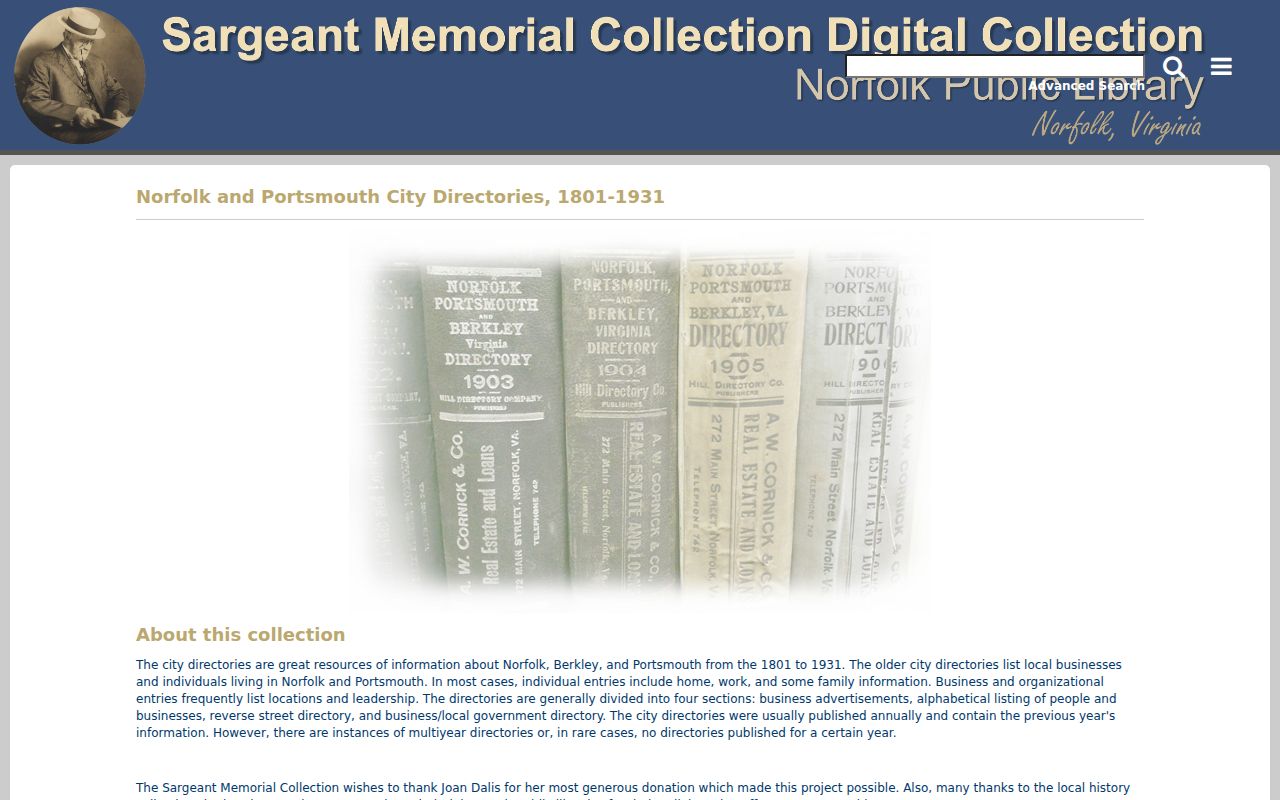
Its collection description reinforces that the same historical volume can be read by name or by street, which is especially useful when an address is known before the occupant.
Old Norfolk addresses can need a second pass under Berkley, Portsmouth, Norfolk County, or a former street name. Hampton Boulevard was formerly Atlantic Boulevard, and annexations changed local labels across the city record trail. Use nearby cross streets, the lot or block description, and the city history material before concluding that a reverse-street search failed. The Norfolk Neighborhood Histories collection supplies annexation maps for that continuity work.
Sargeant Memorial's Norfolk Directories
Sargeant Memorial Collection at Slover Library is the practical Norfolk stop when a scan is unclear or a year is absent online. The non-circulating collection sits on the second floor of the historic Old Norfolk City Hall portion of Slover Library at 235 E. Plume Street. Its regional shelves cover Norfolk, Portsmouth, Chesapeake, Virginia Beach, and nearby places. Along with directories, it holds Norfolk public-record books and microfilm, maps, photographs, manuscripts, yearbooks, and local census microfilm. Those companion materials can settle whether two similar directory entries represent the same Norfolk household.
Sargeant Memorial Collection offers phone and web consultation on Monday from noon to 5, and in-person service Tuesday through Friday from noon to 5. It is closed weekends. Researchers can call 757-431-7429 or email localhistory@norfolk.gov for basic help. Its ArchivesSpace catalog supports full-text searching, record-type limits, chosen search fields, and From and To year filters. Library computers offer Ancestry Library Edition and HeritageQuest, while the research-tools page links FamilySearch, Sanborn maps, Virginia Chronicle, and Norfolk AIR.
Nearly 200 years of Norfolk newspaper microfilm and the 1800–1930 local census microfilm are particularly useful beside the printed books. The collection can help a researcher move from a one-line entry to a map, a death notice, an obituary, a yearbook, or a census household without claiming that every source names the same people.
Tracing Norfolk Directory Households
Use the Norfolk volumes as a sequence of dated sightings. A Norfolk household may change address, occupation, name format, or locality label between volumes. Pair those changes with the federal census, which supplies household composition at ten-year intervals. Federal personal-name schedules are public through 1950 under the 72-year rule. The pairing is useful because the Norfolk directory gives annual-ish address continuity, while a census may add age, birthplace, marital information, and other household context that the directory did not print.
- Start with a known Norfolk year and address from a directory, deed, obituary, or census.
- Search the alphabetical listing, then copy the name spelling, abode, occupation, and family notation exactly.
- Check the reverse street section for that number, neighboring numbers, and variant street spellings.
- Compare the next and prior available directory volumes, allowing for publication lag and skipped years.
- Pair the results with the nearest census, then test departures through newspapers, cemetery records, probate, or deeds.
The National Archives census guide covers federal schedules from 1790 through 1950. Before 1850, many schedules name only a head of household. After 1850, the household evidence becomes much richer, although fields vary by census. Keep Norfolk, Berkley, Portsmouth, and former Norfolk County in the working search terms when a household appears to vanish.
Norfolk Directory Gaps in Newsprint
Newspapers can bridge a Norfolk directory gap. Virginia Chronicle provides a free full-text archive with digitized images and more than five million newspaper pages. Sargeant Memorial also identifies the Virginian-Pilot Collection through NewsBank from 1990 forward and the Norfolk Journal and Guide from 1916 through 2010, while microfilm covers older Norfolk material. Search the Norfolk name with a street, spouse, business, or alternate spelling. Old optical character recognition can miss worn type, so inspect nearby pages around a promising notice.
Birth, marriage, death, social, legal, probate, business, and funeral notices help interpret a changed or missing directory listing. Norfolk's municipal burial database is another endpoint: it supplies a name search and mapped grave location across eight city cemeteries. Missing grave assistance is by phone or email rather than a walk-in search. An interment result identifies a burial context, not every detail of a person's life or family.
Note: A date printed on a Norfolk directory is usually a publication label, so compare it with the collection's warning that many volumes reflect the prior year.
Norfolk Directory Microfilm Backup
When a Norfolk volume or companion record is not online, the Library of Virginia provides a deeper archive route. Its Norfolk microfilm catalog includes city and court books, deed indexes, vital index cards, marriage and vital material, wills, administrative records, military material, and other local series. The former Norfolk locality has general deed-index ranges from 1637 through 1876, plus Hustings and Corporation Court deed-index runs beginning in 1784. Those reels do not replace the printed volumes, but they can link an address or family to the legal record that sits behind an entry.
Library of Virginia's Norfolk microfilm catalog is the starting point for a Norfolk reel-based request or reference search. The catalog also records a missing Circuit Court inventory, appraisement, and account book no. 1, a useful warning when a Norfolk estate trail stops. State archival material, SMC holdings, and the local digital directory collection form a fallback chain: online volume first, library reference support next, then microfilm and archives for the absent series.
Norfolk Directory Place Names
These historic Norfolk volumes need to be read against changing geography. Historic records may say Norfolk County, Berkley, Portsmouth, or an older neighborhood frame where a modern search uses Norfolk city. The city preserves annexation histories for 1890, 1902, 1906, 1911, 1923, 1955, and 1959/1988. The 1923 history records the Atlantic Boulevard to Hampton Boulevard change. A directory household can therefore remain in place while its street or locality description changes around it.
Save both the historic wording and its modern equivalent in a Norfolk research note. Match Norfolk cross streets, lot or block language, occupation, spouse, and nearby directory listings before merging two entries. This Norfolk-specific crosswalk prevents a false conclusion that a family disappeared just because the printed address no longer matches a current map. It also keeps later Norfolk property, court, and vital searches tied to the correct locality.