
Finding Norfolk Residents
Norfolk has no single public roster of everyone who lives in the city. Start with the fact already known. A current street address belongs in the property and map systems. A full name can be checked against a court index, a voter-status tool, or a historical collection. A date or life event may point to the Virginia vital-record index. Each result needs a second check because a parcel owner may use a different mailing address, a voter record is limited by law, and an old directory can describe a prior year.
For a current property connection, Norfolk AIR is often the first useful stop. For a legal ownership question, follow the AIR parcel information into land records. For a past household, the Slover Library collections are more useful than a present-day tax record. This Norfolk residents directory approach keeps the record type tied to the question instead of turning one incomplete hit into a claim about a whole household.
- Enter a current address or street in Norfolk AIR and save the situs address, parcel key, owner display, and sale details.
- Use the parcel's legal description or prior instrument reference with the Circuit Court Clerk's land-record tools.
- Check the Virginia Department of Elections Citizen Portal when voter status, polling place, or district information is the question.
- For an older address, compare the Sargeant Memorial Collection's directories with census, newspaper, cemetery, or deed evidence.
- When an existing public record is not online, ask its custodian for counter inspection, a document request, or a reasonably specific Virginia FOIA request.
Note: Keep a short log of each Norfolk search, including the date, record type, query, and the identifier that made a match persuasive.
Norfolk Offices Behind Resident Records
Norfolk is an independent city, so the City of Norfolk is also the county-equivalent for many record purposes. The Real Estate Assessor maintains the current parcel index. The Circuit Court Clerk keeps deeds, land books, marriage licenses, wills, fiduciary files, and court records. Elections keeps voter-registration functions. These offices answer different questions, and their records should stay distinct. The longer address-by-address process belongs in the Norfolk Street Directory.
Norfolk Circuit Court Clerk's Office
Land Record Division / Secure Remote Access (SRA)
Public counter and Special Index
Subscription remote access available
Land records and deeds
Norfolk Real Estate Assessor
Current property and assessment data
Corrections route through the assessor
757-664-4732
Norfolk AIR property search
Norfolk Office of Elections
City Hall, 810 Union Street, Suite 100
Norfolk, VA 23510
757-664-4353
Virginia Department of Elections Citizen Portal
Norfolk AIR routes factual property corrections to the assessor, while the clerk can route a copy request but does not search land records for a requester. The Norfolk Office of Elections can explain status and protected-record procedures, not disclose fields that the voter statute withholds.
Norfolk AIR Address Records
Norfolk AIR is the city address hub. It accepts an address, tax account number, GPIN, or street name and combines property ownership, assessment and sale history, building information, maps, permits, code cases, civic information, and public-safety geography. A GPIN is the parcel identifier used to keep a property search tied to the correct land. AIR can also narrow a street with ZIP, block, civic-league, ward, zoning, year-built, assessment, sale date, sale value, and parcel-area filters. The owner display is useful property context, but it does not prove every occupant at the situs address.
| Norfolk AIR field | Input | How it helps |
|---|---|---|
| Address, tax account, or GPIN | Text or autocomplete | Starts a parcel-specific search |
| Street name | Text or map browse | Reviews a street segment |
| ZIP Code and Block # | Optional dropdown filters | Narrows a broad property result |
| Sale date, value, assessment | Optional date or numeric range | Compares parcel history |
| Civic League, Ward, Zoning | Optional dropdown filters | Places a parcel in local geography |
Norfolk AIR's search interface shows the address, account, GPIN, ZIP, zoning, sale-date, and year-built filters available for a Norfolk residents directory search.
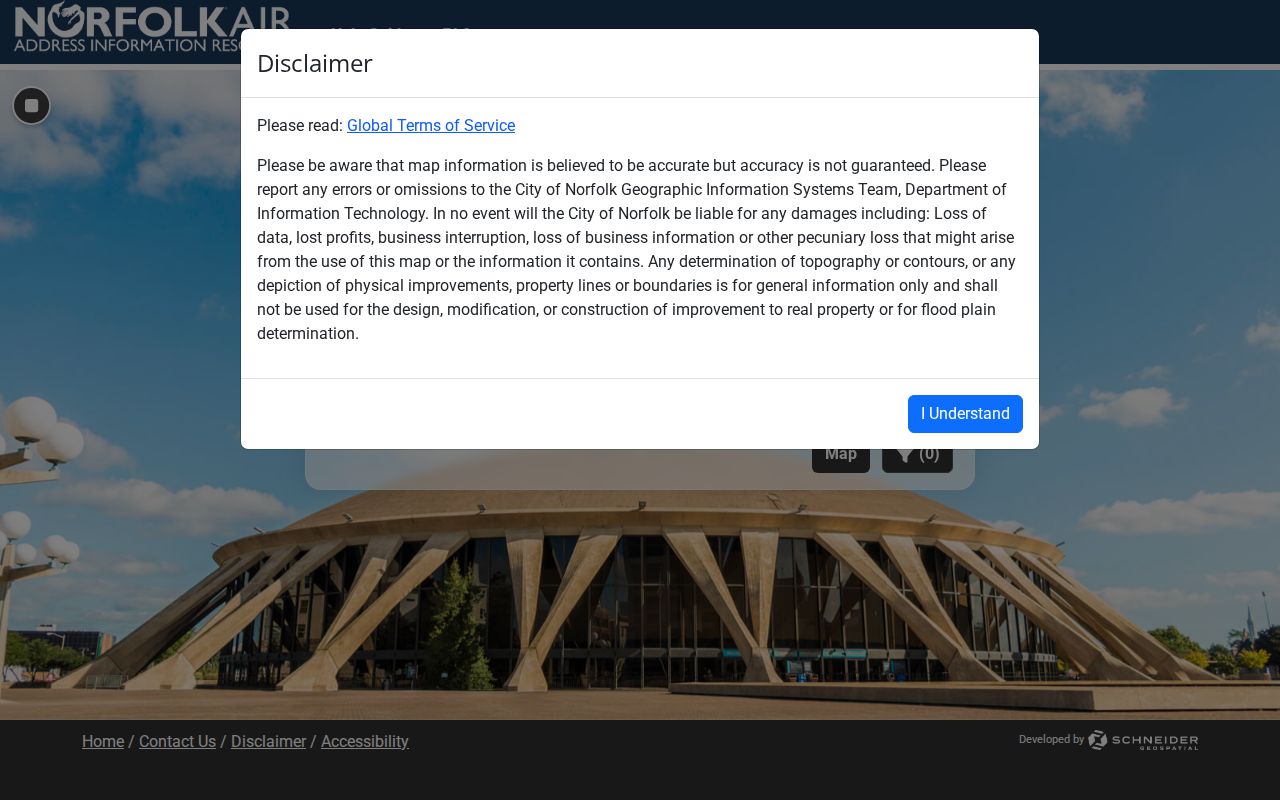
Use the property report as a bridge to another record, not as a complete people list. A parcel map, a mailing address, and a recorded deed can each describe a different connection to the same Norfolk location.
- Parcel
- A defined piece of land in the assessor and map systems.
- Situs address
- The physical location assigned to the parcel.
- Index
- A finding tool that points to a record; it is not always the record image itself.
- Criss-cross directory
- A historical directory arranged by street and number instead of by surname.
Norfolk Resident Rolls Today
Current directory-like records each have a narrow purpose. AIR centers on parcels and owners. The voter system centers on registration functions. The land-record index follows people who signed or received recorded instruments. Civic associations publish organization-level contacts rather than a household roll. Norfolk's municipal cemetery search records an interment, not a current address. A good Norfolk residents directory search selects the source that can actually answer the question.
| Norfolk source | Connection shown | Custodian | Access route |
|---|---|---|---|
| AIR property record | Parcel owner, situs and mailing details | Real Estate Assessor | Free city application |
| Voter information | Status, polling place, districts, voting history | Virginia Elections / Norfolk Elections | Citizen Portal and office channels |
| Land records | Parties to deeds, mortgages, liens, plats | Circuit Court Clerk | Counter, Special Index, or SRA |
| Civic association inventory | Association geography, meetings, public contacts | City of Norfolk | City inventory and AIR routing |
| Burial records | Interment and mapped grave location | Norfolk Bureau of Cemeteries | Free name and cemetery search |
Property ownership and mailing fields answer a different question from voter status or a recorded deed. Verify one person across independent Norfolk records rather than assuming that any one current directory-like source speaks for everyone at an address.
Norfolk Voter Record Limits
The Virginia Department of Elections Citizen Portal offers registration status, polling place, election district, absentee status, and voting-history functions. It is a person and status tool, not a street-wide directory. Norfolk's Office of Elections also provides local registration channels. Under Va. Code §24.2-444, an ordinary public voter list has a limited form: name, address, year of birth, gender, and applicable election districts. Social Security data, day and month of birth, protected residence addresses, and other registration material are excluded.
Norfolk voter-registration information identifies the local office and its service channels for a Norfolk residents directory search.
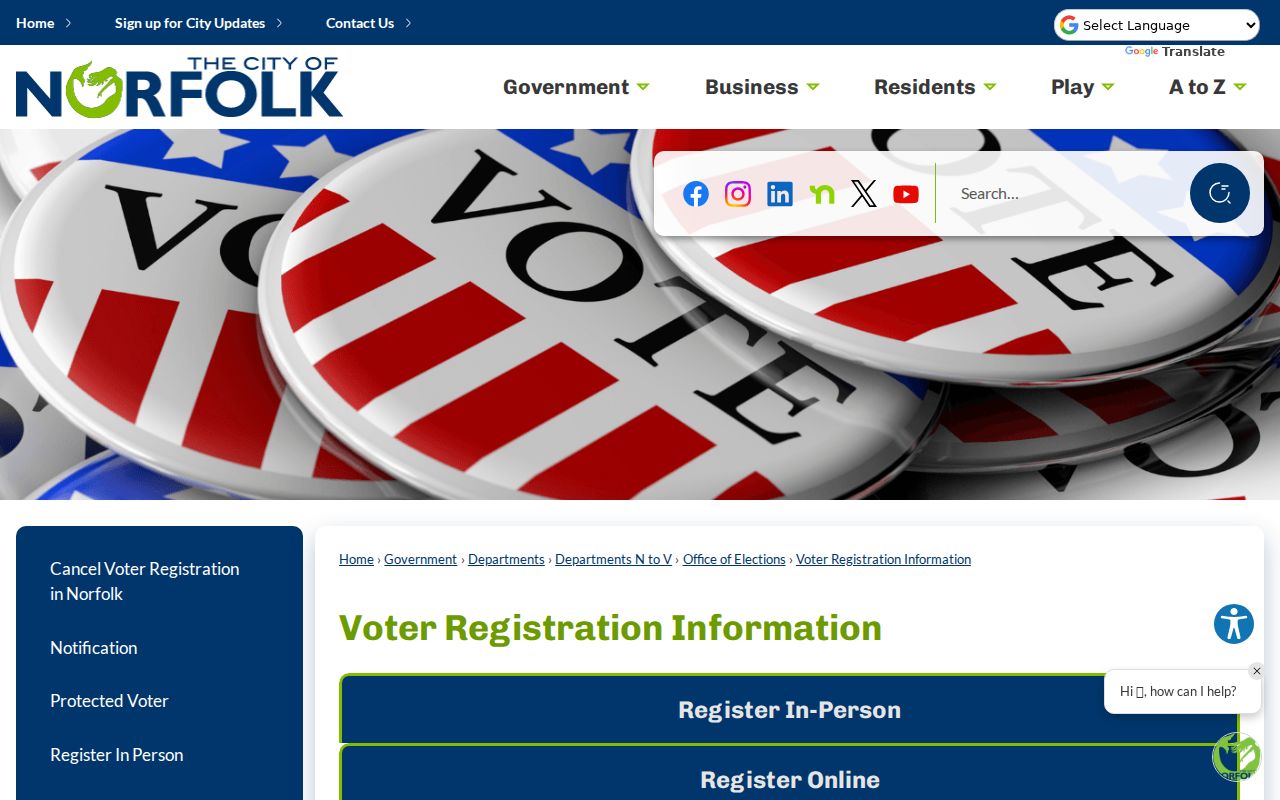
Protected voters and people who are not registered will not appear as an ordinary public-list match. A voter row can support a carefully limited registration conclusion, but it cannot establish every person associated with a Norfolk address.
The Virginia Department of Elections Citizen Portal is the direct online channel for the portal functions. Full voter-list products follow a separate state request process and have client, locality, filter, and use requirements.
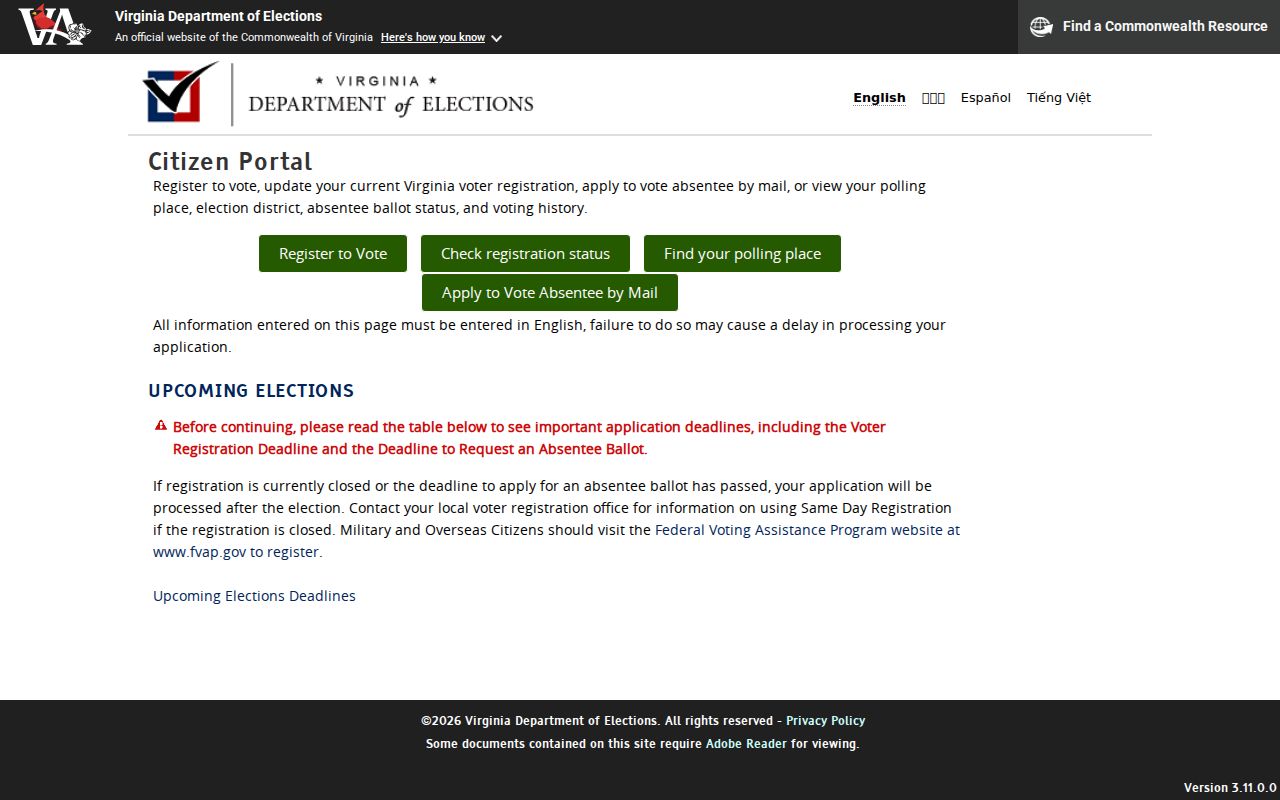
The portal's status, polling-place, district, absentee, and voting-history functions can help test a specific Norfolk record while preserving the statutory limits on the data returned.
Norfolk Deed Record Trails
The Circuit Court Clerk's Land Record Division supplies the legal instrument behind an AIR ownership clue. Start with the current owner, GPIN, lot and block, legal description, or prior instrument reference. A deed can identify grantor and grantee, recording date, consideration, legal description, and earlier references. Search an earlier owner as grantee to move back through a purchase trail, then search that person as grantor to identify a later conveyance. A plat can bridge a familiar street address to the lot described in an older instrument.
Norfolk reports more than seven million imaged land-record images being imported, with images reported back to 1682 in the public record-room Special Index. The remote Secure Remote Access system is subscription-only and lists deeds and land records from 1784 in its coverage table. The counter and Special Index are the alternative when the web subscription is not the right route. Staff do not perform the land-record search for the requester, so retain each instrument reference before advancing.
Note: A deed establishes a recorded legal transaction; it is stronger than a directory clue for title, but it is not a present-household roster.
Norfolk Court Record Checks
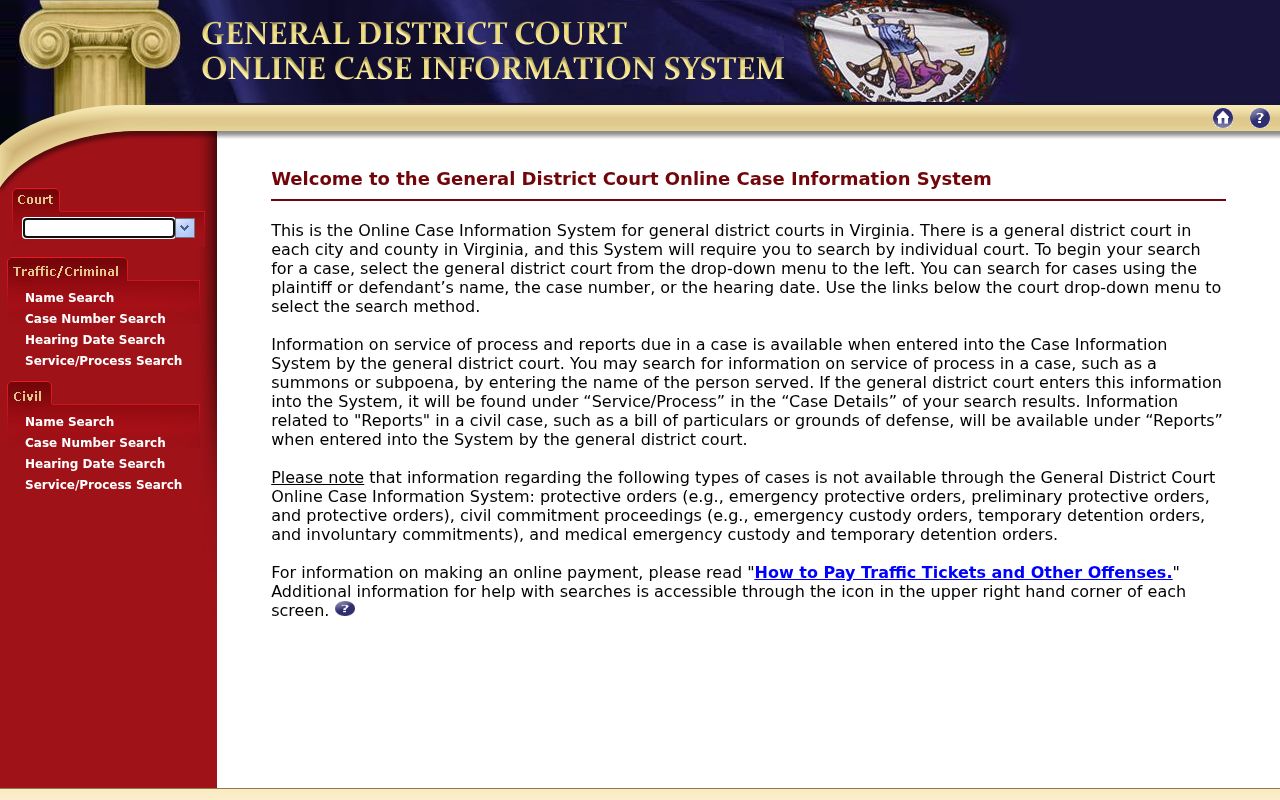
A name needs more than a Norfolk location to be reliable. Norfolk General District Court and Norfolk Circuit Court are separate local routes. The Virginia General District Court system allows a court selector with name, case-number, hearing-date, and service or process searches. Its help supports wildcard searching and separates current and archived cases. Circuit Court searching remains locality by locality, and Virginia does not offer a universal civil circuit search. A case index result can identify a court, case number, party, dates, and entered docket details, but it is not a full case file or a conclusion about the person named.
Virginia General District Court Online Case Information begins with the court selector used for Norfolk General District Court searches.
For a life event, the Virginia Department of Health keeps a public online index under the statutory rules and provides the official certificate route. Birth records open after 100 years, while death, marriage, divorce, and annulment records generally open after 25 years. Current certified copies have identification and relationship rules. The Norfolk Health Department vital-record office provides local walk-in service for Virginia records and lists the current $15 search or copy fee.
Compare the court locality, date, address, and name variation with another independent record. Norfolk court and vital systems have confidentiality limits, so a missing result may reflect a protected, sealed, restricted, or unreported record rather than an absence of the event.
Norfolk Cemetery Record Clues
For family history or an older address, Norfolk's municipal burial search is a useful endpoint. It covers eight city-owned cemeteries and permits a cemetery selection, first and last name, exact match, starts-with, and contains searching. A result can lead to an interment and mapped grave location. The city notes that grave-location help is available by app, map, or phone, not as a walk-in location service. A cemetery result still needs a date and family cross-check before it is connected to a Norfolk directory entry.
Norfolk burial records provides the official cemetery search. Pair it with newspapers when a surname changes, an estate is involved, or a directory entry disappears. The Library of Virginia's Virginia Chronicle is a free full-text historical newspaper archive, while Slover holds nearly 200 years of Norfolk newspaper microfilm on request. Search alternate spellings and nearby pages because scanned text can miss initials and abbreviated names.
Norfolk Records Beyond the Web
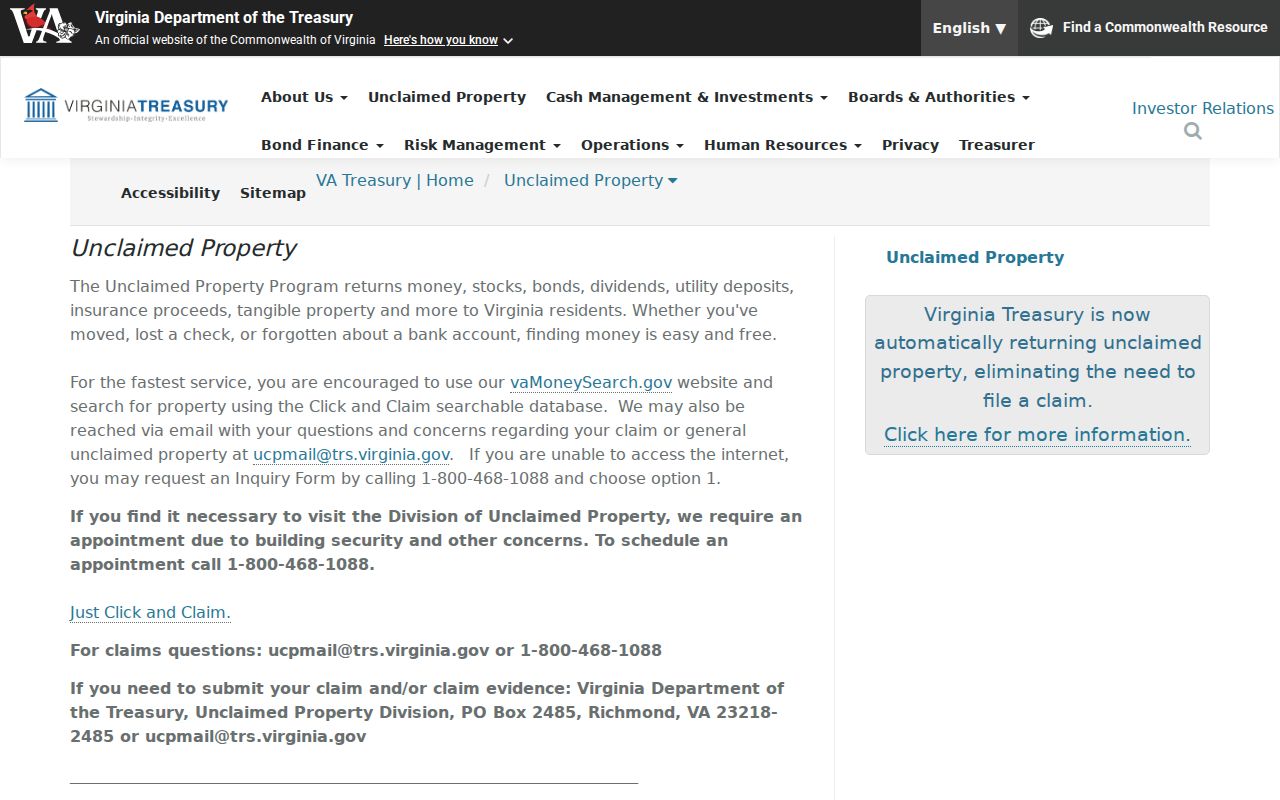
Some useful public records are not held by the city. Virginia's Treasury provides a free unclaimed-property search, and its offline route includes a phone request for an inquiry form. A result can be a prior name or address clue, not proof that a person currently lives in Norfolk. State business and professional-license systems can also help verify a filing or credential, but a business filing address is simply the address reported in that filing. It should not be converted into a personal residence conclusion.
Virginia Treasury's Click and Claim search shows the official online and offline routes for an unclaimed-property inquiry.
When an online route fails, Norfolk research still has a chain: the public counter, a phone or written request to the custodian, Slover reference help, and Library of Virginia archival material. Virginia FOIA allows a reasonably specific request for an existing public record and generally requires a response within five working days, subject to exemptions, extensions, and actual-cost rules. It does not require an agency to create a new list.
Norfolk Historical Resident Directories
Historical directory research is one of Norfolk's strongest resident trails. The digitized Norfolk and Portsmouth collection spans 1801 through 1931 and includes alphabetical and reverse-street material. The first local printed volume was Simmons's Norfolk Directory in 1801, followed by another Simmons volume in 1806. The books usually contain the prior year's information and may skip years, so a volume date must be treated as an observation date rather than a move date.
The Sargeant Memorial Collection at Slover Library holds non-circulating regional directories, newspapers, yearbooks, maps, photographs, census microfilm, and public-record books. Its in-person reference hours are Tuesday through Friday, 12 to 5, while Monday is reserved for phone and web consultations. The complete historical shelf and how to read an entry are covered in the Norfolk Directory Book.
Use a reverse-street listing to connect a number to a historical occupant, then use the alphabetical section, census, newspaper notices, deeds, and cemetery records to test that connection. That sequence is more reliable than assuming a familiar name stayed at one Norfolk address.
Norfolk Annexation Record Clues
Norfolk address research changes when a record uses an older locality or street name. The city publishes annexation maps and PDFs for Norfolk to 1845, 1845 to 1887, 1890, 1902, 1906, 1911, 1923, 1955, and 1959/1988. The 1923 history records that Atlantic Boulevard became Hampton Boulevard during the 1920s. A directory entry may also identify Berkley, Portsmouth, former Norfolk County, or an annexed neighborhood instead of the modern city label.
Use cross streets, a parcel's legal description, nearby numbers, and the street-centerline layer before declaring an old Norfolk result missing. The Norfolk Neighborhood Histories collection provides the city maps that make that local crosswalk possible. This geography detail can turn an apparent gap into a searchable former name.
Norfolk Personal Record Limits
Norfolk public records have firm edges. AIR does not identify every occupant of a parcel. Protected voter addresses and nonpublic fields stay out of ordinary voter access. Vital certificates, sealed court matters, juvenile records, DMV data, and private utility accounts have their own restrictions. The Virginia Attorney General's Address Confidentiality Program can provide a substitute mailing address for eligible participants, while the physical address remains confidential for the program's protected purpose.
Contact the custodian when a record appears wrong: the assessor for property fields, Elections for voter-status procedures, the clerk for land or case routing, and VDH for vital-record requests. A limited or absent result is not an invitation to work around a protection. It is a reason to use the correct official channel or stop the search.